Petrópolis (Rio de Janeiro, Brazil)

The coat of arms was created by Resolution Number 224 of January 8, 1929, with Mayor Paul Buarque. The project was created by Guilherme de Almeida (the same who fought for São Paulo at the Paulista Revolution) and designed by Wasat Rodrigues.
It consists of a Portuguese shield, in blue, and the PII emblem in gold in the Imperial Crown, also in gold, and at the bottom of a mountain, the eagle of Germany in black.
On top of the shield there is a crown of five towers in silver. At side rails and their sleepers in natural color surrounded by blue ribbon, which, in gold letters, is the inscription "Semper Altiora Petens".

The Portuguese shield is a tribute to the discoverers of Brazil.
The crown and the PII emblem is a tribute to the founder of the city, Dom Pedro II.
The mountain is the Serra da Estrela, where the city is located.
The Crown in silver with five towers on top coat is a Portuguese symbol for cities.
The rails with sleepers recall the Petrópolis glory of owning the 1st railway built in Brazil.
The Latin inscription "Semper Altiora Petens"  mean Always Seeking The Highest
The eagle, refers to Germany, home of the first settlers of Petrópolis.

State: Rio de Janeiro
Country: Brazil
My Commentary: Petrópolis, although being in Rio de Janeiro, has all elements of being a very interesting town. It's on the mountains, it's full of History and in this case related to the Imperial Brazil, it had German settlers, it has many historical buildings and the people and the politicians care about them. Surely one of the best destinations in Brazil.

Links:
A História de Petróplis - A Facebook page about Petrópolis' History

Interesting Facts:
- Petrópolis is considered the first planned city of Brazil with a project by Júlio Frederico Koeler. He divided Petrópolis in many areas and many of them with locations' names of Germany.

- When the first radio transmission took place in Brazil in 1922, there were 3 receivers of the signal: One in São Paulo, one in Niterói and another one in Petrópolis.

- The first summer that the Imperial Family spent in Petropolis was in 1847-1848 when they stayed at Casa Grande of the farm at Córrego Seco.

- The first Germans to arrive in Petrópolis came in 1823 on board of the ship "Justine". The ship was comig from Havre to Autralia when the commander of the "Justine" decided to make a scale in Rio de Janeiro due to a passenger mutiny because of the bad treatment they were having. Those 235 people stayed in Brazil and were relocated to Petrópolis and because of the good results they had at work, many Germans came afterwards.

History of Petrópolis: In 1830, D. Pedro I bought Córrego Seco Farm to built the royal residence in the highlands of Rio de Janeiro, where the Imperial Family used to escape from the hot summer of Quinta da Boa Vista. In Europe, 19th Century, it was created a tendency that after sometime was allowed to all population: the vacation. Royal families used to build the house in a different place, in order to have a good rest during the summer vacation. The Russian Czars had their houses in St Petersburg; the French crown went to Versailles Palace. The Brazilian Empire also has summer vacation time. However, the court did not like the D. Pedro I project. They said that the farm did not provide the minimum of men and horses to cross the streets. The things became worst when the local that was chosen to be the city center was a swamp, full of insects. But there was someone that enjoyed the idea and used to spent unforgettable vacations, the Imperator’s son, little Pedro. In 1831, D.Pedro I abdicated the throne and went back to Portugal. The little Prince, Pedro, was left in Brazil, in order to start his preparation to govern the colony. During 12 years, the project Petrópolis habitation was almost forgotten, but there was a man that revived this project, the engineer and military Júlio Frederico Koeler. Koeler was born in Hesse-Darmstadt and became Brazilian naturalized. In 1837, he built parts of the road Serra da Estrela and Estrada do Itamaraty, without the use of slavery workforce. He convinced German immigrants that were dissatisfied with the treatment they were receiving in the ships to stay in Rio de Janeiro. Thus, on March 16th 1843, D. Pedro II signed the decree 155, in which Koeler was allowed to build the town, the summer palace, a church and a cemetery. After this well succeeded experience with German immigrants, Koeler brought more 2 thousand Germans to Petrópolis. Petrópolis became the first projected city from Latin America, with its dominated rivers, its gardens and its big houses. After its construction, the Imperial City received its legacy. Until today it is possible to visit and revive the colonial period through the buildings and projected streets. (source)


Anthem of Petrópolis:
Geraldo Ventura Dias is the author of the Anthem of Petrópolis, he won a contest to the official anthem held on July 20th 1972.

Petrópolis,
tens do passado gloriosas tradições,
Petrópolis,
cultura e fibra de homens de outras nações,
Que lutaram e criaram as riquezas,
guardaram as belezas
que devemos defender.
Petrópolis,
tranqüilidade, nossa fonte de saúde;
Petrópolis,
o teu futuro é a tua juventude
que estuda e trabalha consciente
de que a luta no presente,
vitória vai trazer.
Para frente, para o alto,
construir,
com amor e com vontade,
progredir,
vem viver aqui na serra,
onde a sorte nos sorri.

Quem pensa que é feliz em outra terra
é porque
ainda não viveu aqui.
Original video by Débora Damieri


My Photos in Petrópolis 2015
Part of: Trip: Rio de Janeiro, Petrópolis and Penedo 
It was really a relief to arrive to Petrópolis, while driving up the hill the traffic was too slow and the sun was still burning, so arriving there was completely welcome. The difference from Petrópolis to Rio de Janeiro City is enormous. As it's possible to see in the pictures, the place is more like a mountain town with many historical buildings and even the people is different. Petrópolis was the biggest surprise for me during that trip since it was my first time there.

My video of a car ride in Petrópolis


Saint Peter of Alcantara Cathedral - A wonderful French gothic building with a mausoleum with remains of some members of the Brazilian Imperial Family.


The front view from the Cathedral at night

The front view from the Cathedral at night

Praça Princesa Isabel -22.505925, -43.179752

Praça Princesa Isabel - In this park there is a monument for the first German settlers who were brought to Petrópolis by request of the Emperor Pedro II

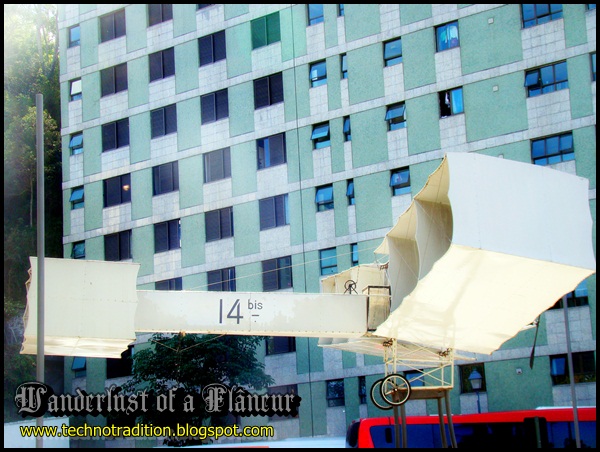
A monument in tribute to 14 Bis

Central area of Petrópolis

Central area of Petrópolis

View from from Bohemia Brewery

View from from Bohemia Brewery

Bohemia Brewery - RJ -22.506602, -43.185009

Bruno and I having lunch at Bohemia brewery

The cathedral in a view from Av. Köeller


Brazilian Expeditionary Force Museum - Brazil at World War II

Brazilian Expeditionary Force Museum - The logo of Brazil, a smoking snake, which means things will be brutal.


Logo of "Senta a Pua" another inspiration motto of Brazil during World War II


 German styled houses

 German styled houses


Rio de Janeiro City (Rio de Janeiro, Brazil)

The flag of the City of Rio de Janeiro is a white field with two blue stripes, placed diagonally, forming a band and a bar (that is, in the shape of a saltire, or a St. Andrew's cross). On the crossing of the band and the bar, the city's coat of arms—a sixth in proportion to the total field—appears in red. The city's coat of arms has the following heraldic composition: on a red field, there are three silver arrows surmounted by a silver armillary sphere, and over all a silverPhrygian cap. Supporting the shield are two red dolphins, holding at their right a laurel branch and at their left an oak branch. The crest of the shield is a mural crown of five towers, also red. The tinctures, or heraldic colors, of the coat of arms on this shield are altered from the traditional coat of arms, which has a blue field, golden arrows and sphere, and a red Phrygian cap. The dolphins are normally silver, the leaves they hold green, and the mural crown gold. The blue and white of the flag symbolize the Portuguese origin of the city, as they are the traditional colors of the Portuguese monarchy, adopted since the creation of the County of Portugal in 1097. (It was only after the proclamation of the Portuguese Republic on October 5, 1910 that Portugal began to use the colors dark green and red on their flag.) The color red on the flag of Rio de Janeiro symbolizes the blood shed by Saint Sebastian, the saintly patron of the city, as well as the blood shed by the city's founder, Estácio de Sá, and the early settlers of Rio de Janeiro. (Wikipedia)
State: Rio de Janeiro
Country: Brazil
GPS Coordinates

My Commentary: As a Paulista, it's complicated to me to talk about Rio de Janeiro. Anyway, technically saying this city is structured and has an important role in Brazil's History. The geography together with the nature makes it a nice place to stay. The obvious problem of Rio de Janeiro is the criminality, the poor culture of people and corruption. Those problems are not exclusive of Rio but are common there and part of the daily life. I must also say, in other hand, that Rio de Janeiro has its elite, people from traditional families who try to keep Rio in the glory it had before, but it's a vain work nowadays as the media and the "non-elite" share proudly the favela culture which exalts crime, prostitution of young girls and illegal events with loud music .

Links:
Curiosidades Cariocas - Historical Facts and Photos of Rio

Interesting Facts:
- There is a rivalry between the Paulista people from São Paulo State (mainly from São Paulo City) and the people from Rio de Janeiro State (mainly the cariocas from Rio de Janeiro City). Even in football this is true: There was a championship named Rio-São Paulo Championship.

- Rio de Janeiro was already under French domination, which was the France Antartique.

- Rio de Janeiro was already the capital of Brazil (until Brasília came into being)

- Rio de Janeiro is well known as "Cidade Maravilhosa" (Marvellous City)

- Pão de Açucar is a single rock, which is 395 meters tall. This formation is 610 million years old. (source)

- Guanabara Bay has 100 islands. (source)

- Copacabana was once elected the most beautiful beach in the world.(source)

- The sky of Rio de Janeiro was considered the bluest in the world, according to NPL criteria (The National Physical Laboratory). (source)

- The name Copacabana means "blue look-out point" (source)

- The city of Rio de Janeiro has the second largest GDP in Brazil and the 30th in the world (the first one in Brazil is São Paulo City)

- Rio de Janeiro is the main tourist destination in the Southern Hemisphere.

- At the World Cup of Football in 1950 Brazil lost the final match in Rio de Janeiro against Uruguay (Maracanã Stadium)

- There is a myth which tells that at Pedra da Gávea there is a portal to Agartha, a place in another dimension.

History of Rio de Janeiro: Rio de Janeiro was discovered by Portuguese conquistadors on January 1, 1502. They mistook the large Guanabara Bay for the mouth of a river, thus the name River of January, which has remained ever since despite the misnomer. The French began scouting out the area in search of brazil wood, so the Portuguese decided to establish the city of São Sebastião do Rio de Janeiro on March 1, 1565, to resist French occupation. *brazil wood was valued for its red dye*
The country's first capital city of Salvador da Bahia was transferred to Rio in 1763. In 1808, Napoleon's army began the invasion of Portugal and the King Joao VI decided to move the monarchy to the 'Marvelous City', Rio de Janeiro. The city had its colonial status elevated to the United Kingdom of Portugal at that time. Brazil's independence from Portugal anointed Rio de Janeiro as the official capital of Brazil in 1822, allowing Rio to grow to one of the world's largest cities by 1891 with 500,000 inhabitants. This brought in huge growth, with mountains removed, waterfront reclaimed and skyscrapers being built. One can easily understand the need to expand after seeing the distinctly abrupt scenery of Rio de Janeiro, sandwiched between steep escarpments of mountain and sea. In 1960, the world's premier planned city of Brasilia formally opened up in the interior of the country, thus officially dethroning Rio de Janeiro as the national capital of Brazil. Rio continues today to be the cultural and emotional capital in many aspects of Brazilian culture. Lots of the federal politicians still scurry back for weekends. (source)

Anthem of Rio de Janeiro:
The anthem of the city of Rio de Janeiro is named Cidade Maravilhosa (Marvellous City), a march composed by André Filho and arranged by Silva Sobreira for the Carnival in 1935. This epithet for the city was used by the French writer Jane Catulle Mendes in his book of poems La Ville Merveilleuse published in Paris in 1913 as a tribute to the natural beauty of Rio de Janeiro. In the 1960s, the march song of André Filho was established as the official anthem of the city.

Cidade maravilhosa, cheia de encantos mil
Cidade maravilhosa, coração do meu Brasil!

Berço do samba e das lindas canções,!
que vivem n’alma da gente.
És o altar dos nossos corações
que cantam alegremente!

Cidade maravilhosa, cheia de encantos mil
Cidade maravilhosa, coração do meu Brasil!

Jardim florido de amor e saudade,
Terra que a todos seduz...
Que Deus te cubra de felicidade...
Ninho de sonho e de luz!

Cidade maravilhosa, cheia de encantos mil
Cidade maravilhosa, coração do meu Brasil
Original video by DeroVolk


My Photos in Rio de Janeiro City 2015
Part of: Trip: Rio de Janeiro, Petrópolis and Penedo 
We arrived at late evening to the concert and that was totally crowded, we were late and couldn't find the main entrance so that was a tense moment. On the way, talking to a Carioca girl, we got the affirmation "I didn't know you Paulistas liked Los Hermanos" and that was an interesting nice observation considering her style and I answered in my mind "I don't know why I like the band and can't believe I came to Rio". That was a very good concert, they play perform well live, they played the songs we like and people sang together all of them (one thing I admit: they've got real fans).
For the next day I planned "Well, we go to some tourist places enjoy for a while and then at the end of the afternoon we go to Petrópolis" but then problem was that that was Saturday and on Monday it would be holiday, so Rio was like hell (Hell de Janeiro), we couldn't park the car, there were no parking areas anywhere, the heat was killing us, when we found a parking lot a strange carioca man came saying we needed to give him money to stay there, the tourist areas and places were all crowded, the radio stations only played shit music and then we got fed up and headed towards Petrópolis earlier than the planning. That's why I have just a few pictures, some of them even taken from inside the car.


The so frightening Linha Vermelha (Red Line)

On the way to Petrópolis -22.809323, -43.270705